
Your home didn't sell. That's a symptom, not a sentence.
You've probably been told that any motivated agent would gladly take on an expired or cancelled listing. Here's a more useful way to see it: a home that didn't sell is a symptom — and a symptom deserves an intelligent diagnosis before anyone prescribes a fix. This is how a seasoned listing team actually reads yours, and what it means when we believe it will still sell.
Selling homes that didn't sell the first time isn't beginner's work. Done well for years, it's the opposite.
There's a common belief in real estate: that expired and cancelled listings are the leftovers — the homes any hungry agent should be glad to chase. The truth is closer to the reverse. Doing this work well, for years, without going broke, takes a kind of judgment that is rare and hard to build.
New agents are taught, without anyone saying it out loud, to take everything. A listing is a listing. The sign in the yard is exposure. Surely some of them will sell. So they say yes to almost every seller who will have them — and then quietly learn what it costs. That cost only lands on the agents who actually planned to market the home well and represent the seller with care. The ones who never planned to do either don't feel it. They simply take the listing and hope.
The teams still doing this a decade or two later, at a high level, did the opposite. They learned — often the hard way — that the most important decision in this business is made before any contract is signed: who to represent, at what price, in what condition, in what market. Get that decision right again and again, and you build a lasting business and a name for selling homes. Get it wrong again and again, and you spend yourself out of the profession.
So when you find a team that has focused on expired and cancelled homes for years — and historically closes 90% or more of the listings it takes on — you are not looking at agents who couldn't win "better" listings. You are looking at the rarest thing in this business: people who can tell, ahead of time, which homes will sell and which ones won't. That skill is the whole game.
The most important decision in this business is made before any contract is signed.
It's rarely just one thing. And it's rarely your fault.
It's the first question every seller asks: why didn't my home sell? A listing rarely expires for a single reason, and almost never because something is wrong with you. It expires because — at the price it was set, in the condition it was shown, with the marketing it got, in the market as it stood — a buyer didn't say yes. Usually it's a mix of those things, not one cause.
It's seldom as simple as "the last agent was bad," and seldom as simple as "the seller was unreasonable." Sometimes a good agent never told the seller the price the market would actually reward. Sometimes the agent pushed hard for a price drop, and the seller — for reasons that are often completely fair — couldn't or wouldn't go there. Sometimes a home sat at one price for months because no one explained what the data was really saying.
And sometimes, in fairness, part of it really was the agent. Maybe they weren't motivated enough. Maybe communication slipped, the updates went quiet, and the seller felt forgotten. Maybe they settled for weak photos or thin marketing when the home deserved better. Most agents work hard and mean well — but when a home doesn't sell, honest people have to be willing to look at every reason, including that one.
And sometimes the price isn't about willingness at all. Dropping below a certain number would mean the seller has to bring cash to the closing table that they simply don't have. That's not motivation — that's math, and it changes everything about what's possible.
These differences matter, because they decide what can actually be done. Sorting out which one is really at work — before promising anyone anything — is the first real job of a serious listing team.
Almost every situation lives somewhere on each of these four things.
When we look at an expired or cancelled home, we're really weighing four things at once. They affect each other. A strength in one can make up for a weakness in another — and a bad combination can take a home off the table completely.
Is the asking price within reach of what today's market — recent nearby sales, the homes you're competing with, current rates and inventory — will actually pay? A hopeful, higher-than-market price isn't a character flaw; it's just information. But a home priced above what buyers will pay won't sell, no matter who lists it.
What shape is the home in — including the things that cost little or nothing to fix? A home left unattended even where attention is free tells us something. Usually it's about time and energy. Sometimes it's about how ready the seller really is.
Beyond condition: how the home shows. Staging, neutral colors, clearing clutter, removing the most personal touches. A home you love living in can be wonderful — and still be hard for a stranger to picture as their own.
How ready is the seller, really — not just to sell, but to do the reasonable things selling takes? Motivation is the quiet factor that ties the other three together, and it's the one people misread most.
A hopeful price isn't a character flaw. It's information.
The hardest kind of readiness has nothing to do with price.
Most people think motivation is about price — whether a seller will lower it. Price is part of it. But there's a quieter kind of motivation that newer agents miss completely, and it deserves an honest, no-blame explanation, because it affects more sellers than almost anything else.
It's the willingness to prepare the home for the market it's actually walking into.
Picture a home that would do well — good bones, fair price, decent location — owned by someone who has lived in it and loved it for years. It's full of their taste: bold colors, personal touches, a layout built around their life. None of that is wrong. It's what made the house a home. But most buyers can't see past it, and asking them to is asking a lot.
A seller who's willing to bring in a stager, listen, and act on the reasonable advice — soften the loud colors, clear the clutter, depersonalize, let the home photograph as a space a stranger can imagine owning — is showing real motivation, even if the price never moves. A seller who would rather show the home exactly as they love it is making a completely understandable choice — and usually showing that they aren't quite ready to let it go on the market's terms.
There is no judgment in this. It simply has consequences. A very personal home can still sell. But it usually waits longer — sometimes much longer — for one particular kind of buyer: someone with the vision to see past the surface, and the willingness to pay for changing it themselves.
When that buyer finally shows up, their offer reflects exactly that math. It starts with what they believe the home is worth — then comes down for the extra time it has sat on the market compared to other homes, and comes down again for what it will cost them to make it their own.
So when we look at motivation, we're not asking whether you care. We're asking — gently and specifically — whether the situation and the willingness are there to give the home its best real shot. That's a judgment call made in real time, and it's one of the parts of this work that takes years to learn to read.
There is no judgment in this. It simply has consequences.
Selectivity isn't arrogance. It's math — and a refusal to waste your hope.
Here's the part most sellers are never told plainly, so we'll just say it.
In the usual setup, a listing agent is paid only if and when the home sells — a percentage of the sale price, at closing, and nothing before that. So everything spent getting there — professional photos, marketing, the paperwork, the steady stream of updates and check-ins — is spent at the agent's own risk. If the home doesn't sell, that money and time are simply gone.
And it goes further than most people outside the business ever realize. Most agents who have lasted a decade or more have had months where they effectively paid — sometimes thousands of dollars — for the privilege of going to work. For salaried people, that's almost impossible to picture, but it's exactly how it sounds. There are months where a top producer covers office space, a website, photography, signage, MLS dues, marketing, and technology, shows up Monday through Friday and often weekends, well past forty hours — and not only earns nothing, but ends the month down thousands of dollars. This is the side of real estate no one talks about. It's also why smart decisions about which homes to take matter so much.
Most agents who have lasted a decade have had months where they paid, out of pocket, for the privilege of going to work.
Now picture a team that takes fifteen listings in a month without doing real homework on any of them, and spends, say, fifteen thousand dollars bringing them all to market. If those homes were never truly sellable at their price and condition, the team has thrown that money away — and that's the smaller cost. The bigger cost falls on fifteen hopeful sellers who were set up to expect something that was never coming. Every couple of weeks they ask for an update, and every couple of weeks the honest answer is the same: little traffic, no offers, no movement. Hope drains. The mood turns grim. And the agent is the one who has to sit across from each of them and explain that nothing has changed.
That's the real reason a serious team is selective. Not ego — math, and a refusal to spend your hope on a sale we don't believe in. Saying no to the wrong home is exactly how we protect our ability to do extraordinary work on the right one.

If we want to represent you, you're not one of the many. You're one of the few.
Now turn it around.
If one of our listing specialists has studied your home, your price, and your situation — and still wants to represent you — that is not a small thing. It's the opposite of taking every listing in sight. It means that after the kind of homework most agents never do, we believe your home is a sellable product, and that what we propose can honestly match what we think we can achieve on price and on time to sell.
If yours is one of them, you have a far better chance of selling than most homes around you — precisely because we don't chase the ones we can't move. Being chosen here is a sign of strength, not a last resort.
A good doctor diagnoses first, then treats — and tells you the truth either way.
A good doctor doesn't hand the same prescription to everyone who walks in. They diagnose first, then treat — and sometimes the honest answer is that a different path is wiser. We work the same way.
Before we tell you what we believe, we do the work. We call it our experience-driven, AI-enhanced market analysis — a clear, honest read on your price against the live market, your home's condition and presentation, your equity position, your timeline, and the real range of outcomes. Years of judgment, sharpened by technology most agents simply don't have.
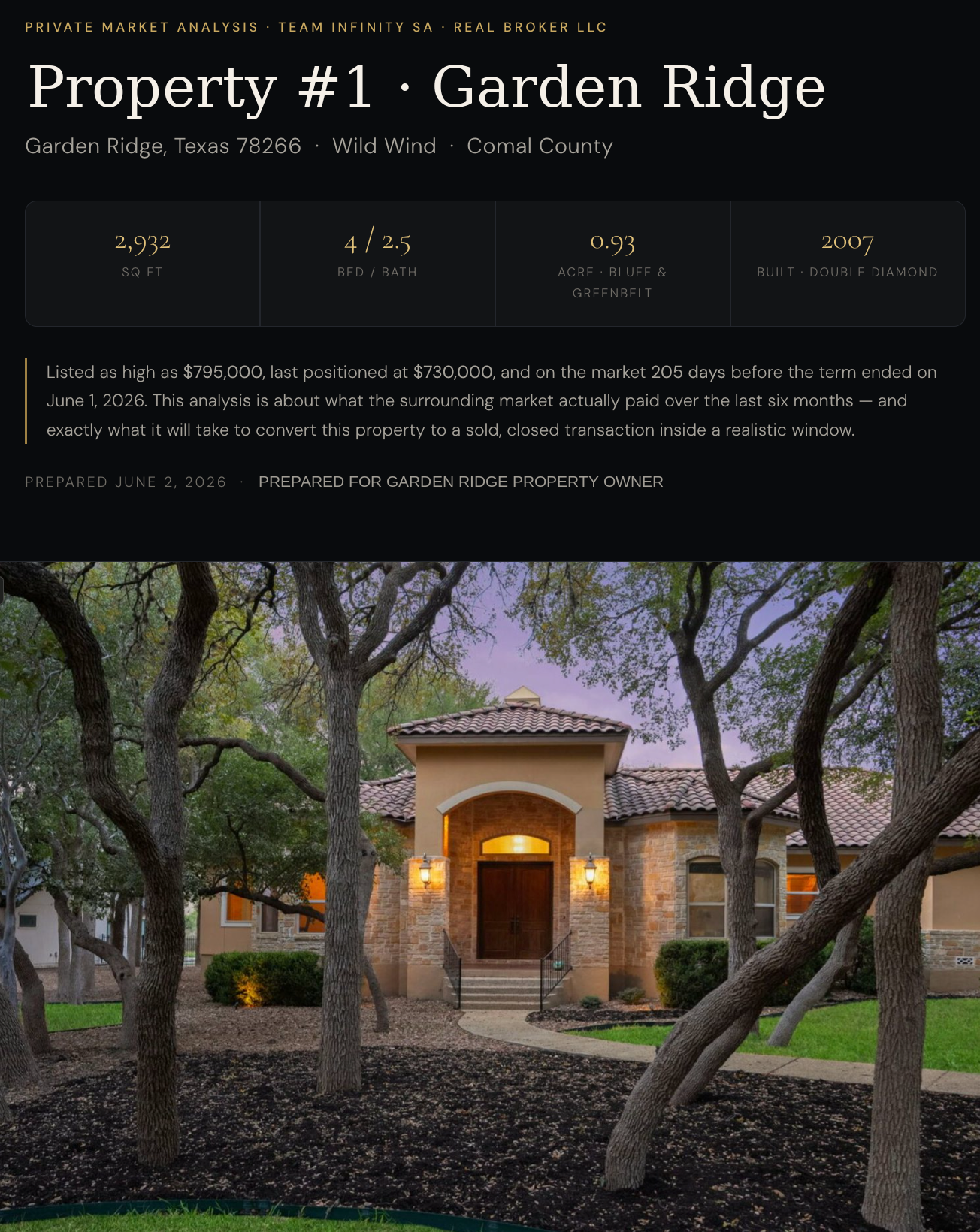
Sometimes we know quickly. Sometimes we don't have the answer until we've done the legwork. Either way, when it's done, you get the truth — not a sales pitch dressed up as optimism.
If we believe we can meet your goals on price and timeframe, we'll say so plainly, and show you exactly how. If we don't, we'll tell you that too — and we'll do our best to lay out whatever real options you have:
What it will never mean is taking your listing, your money, and your hope on a sale we don't believe in. Most people, in our experience, just want the truth. When the options are limited, we owe you that — and the honest admission that sometimes the market, the equity, or the home's condition won't allow a sale on the terms you need right now. We can't change all of those things. But you will always know exactly where you stand.
A tough market is a tough market — at $300,000 or at $3,000,000.
A home that needs a fresh diagnosis has the same need whether it's a three-hundred-thousand-dollar house or a three-million-dollar one. The scale and the solutions are very different. The need — accurate pricing, an honest read, and creative marketing — is exactly the same. Our problem-solving, our precise pricing, and our marketing are what let us serve very different homes well.
That holds across property types as much as price points — single-family, condo, or multifamily — and across the area we serve: San Antonio, New Braunfels, Austin, and the wider Central Texas region. With access to as many as seven MLS systems across these markets, the odds are high that we can not only work your home, but work it at a very high level.
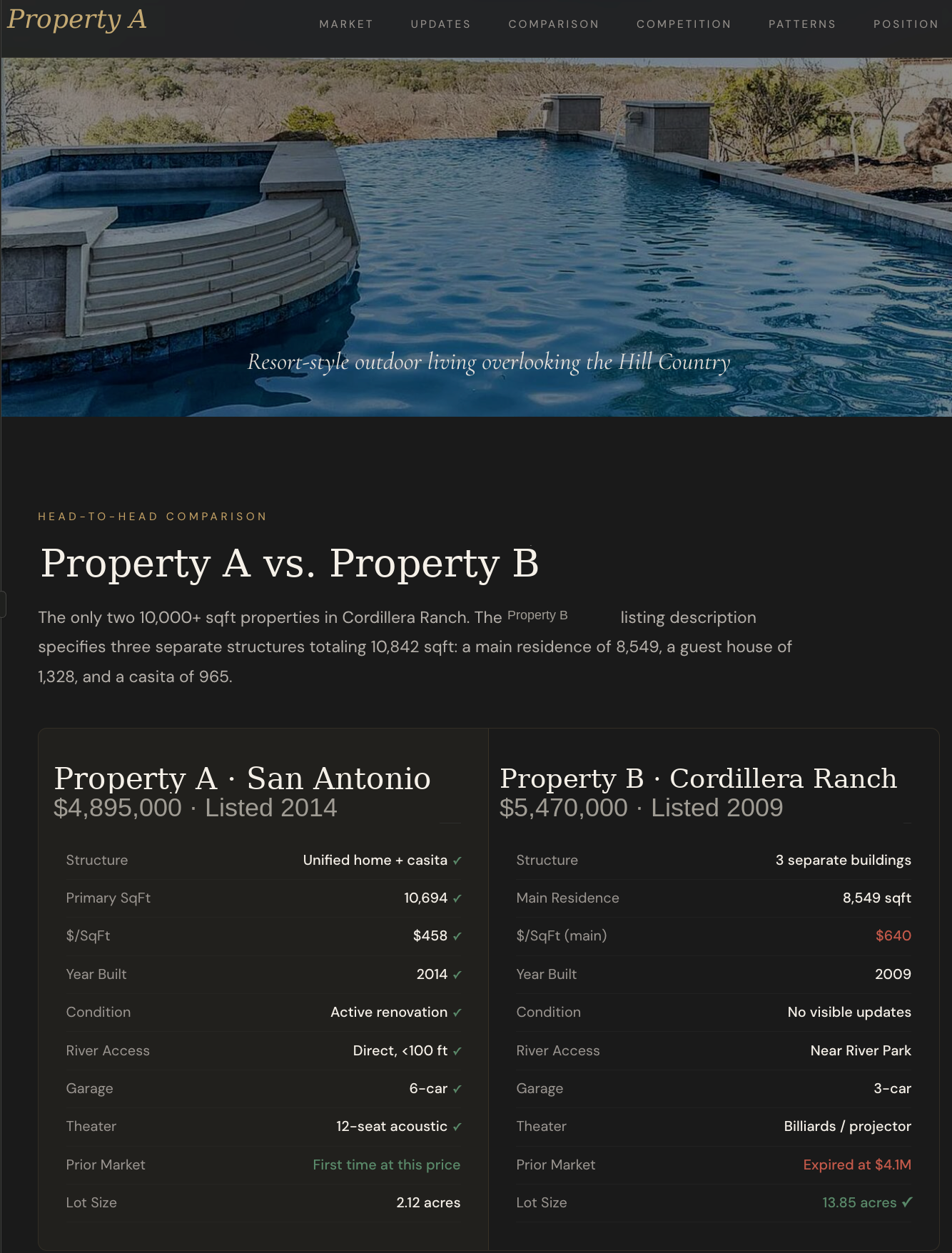
And where we can't — when a home sits outside the areas we serve well — we won't pretend otherwise. We keep a strong referral network, and we'll gladly connect you with a local expert we truly believe will do the best job for you. The goal is your outcome, not our name on the sign.
Suddenly, everyone is an "expired specialist." Here's how to tell who actually is.
For years, this work wasn't a popular business model. In easy conditions — roughly 2012 through 2019, and stretches of 2020 and 2021 — the market itself carried home sales across the finish line, even when much of the work was done poorly. Focusing on homes that didn't sell was the hard road, and few took it. Now that conditions are challenging and selling a home takes real analytical rigor, the "expired specialist" label has become fashionable almost overnight. The label got popular. The specialization didn't get easier.
So apply a simple logic test. If an "expired specialist" website routes you to whichever agent on a large team happens to be next in the rotation, not everyone on that roster can truly be specialized in this work — you haven't found a specialist; you've entered a marketing funnel. Expired and cancelled sales demand more tenacity, discipline, emotional management, and hard decision-making under pressure than most agents are willing or able to sustain. That is precisely why true specialization is rare, and likely always will be.
Our work in this arena has drawn attention — including imitators who have copied our content, and even our visuals, as closely as they could. Flattering, in its way. But set an imitation beside the original and the difference shows, because the substance of this work cannot be copied. The market intelligence and depth of analysis cannot be copied. The track record of diagnosing why homes fail to sell — built case by case over decades — cannot be copied on any timeline shorter than the one we lived. A look can be duplicated. A decade or two cannot.
Our concern isn't the competition — it's the client experience. When a property owner is never properly consulted because the person behind the "specialist" label doesn't carry the judgment the label promises, it's the owner who pays for it: in months lost, in price reductions, in a home that develops a history. That, ultimately, is the difference in who you hire.
You've seen this movie before with the word "luxury" — agents branding themselves luxury specialists with zero luxury listings and little to no experience in that realm, ever. Whatever the label, the protection is the same: ask the person who would actually handle your home for their track record with homes like yours. Not the team's. Not the brand's. Theirs.
Specialization can be claimed by a group. It can only be carried by an individual. Evaluate the individual.
The honest answers — before you ever pick up the phone.
Why didn't my home sell the first time?
Almost always for a combination of reasons, not one — some mix of price relative to current comparable sales and competition, the home's condition, how it was presented and staged, the seller's circumstances, and the state of the market. A listing rarely expires because of a single cause, and almost never because something is wrong with you.
The useful work is figuring out which of those factors actually held it back, because that determines what can be changed.
Does working expired and cancelled listings mean an agent is inexperienced?
Usually the opposite. Newer agents tend to take any listing they can get and learn the hard way what it costs. A team that has focused on expired and cancelled homes for years — and closes a high share of what it takes on — has had to develop something rare: the judgment to forecast, accurately, which homes will sell and which won't. Sustained success in this niche is a sign of strong business acumen, not a lack of it.
Should I just relist my expired listing at the same price?
Not without a fresh diagnosis. The same price, the same condition, and the same presentation, put back into the same market, tend to produce the same result. Before relisting, it's worth reassessing your price against today's comparable sales and active competition, the home's condition and staging, and your own timeline and goals. Sometimes the fix is straightforward; sometimes it isn't — but guessing is expensive.
What does it mean if a listing team turns my home down?
It's a judgment about whether the home can sell under current conditions at a price that works for you — not a judgment about you. Because a listing agent is generally paid only when the home sells, a serious team can't take on homes it doesn't believe it can move; doing so wastes the seller's time and optimism as much as the agent's money. A team that's honest about what it can't do is usually being honest about what it can.
What does it mean if Team Infinity wants to list my home?
It means that after the kind of pre-listing diligence most agents never perform, we believe your home is a sellable product and that what we propose can honestly align with what we think we can achieve on price and time to sell. By our own candid estimate, only somewhere in the range of fifteen to twenty percent of expired and cancelled homes clear that bar in a market like this one. If yours does, you have a far better chance of selling than most homes around you.
What are my options if my home truly can't sell right now?
We'll tell you the truth and lay out whatever real alternatives exist. Depending on your situation, that might mean staying in the home and waiting for a better market, having a conversation with your lender about a short sale where equity is the constraint, or renting the property if that's viable.
Sometimes the honest answer is that the market, an equity position, or a home's condition won't allow a sale on the terms you need right now — and you deserve to know that plainly.
Do you only work with luxury or expensive homes?
No. A challenging market creates the same need for accurate pricing, honest assessment, and creative marketing whether a home is three hundred thousand dollars or three million. We work single-family, condominium, and multifamily properties across San Antonio, New Braunfels, Austin, and the wider Central Texas region. If a property sits outside the areas we serve well, we'll gladly refer you to a community expert we believe will do the best possible job.
The next step is simple: let us run the analysis.
If your listing expired, or you cancelled it, let us build you an experience-driven, AI-enhanced market analysis — a clear, honest read on what your home can realistically sell for, how long it may take, and what (if anything) would move those numbers. We can't promise a guaranteed sale — not in a tough market, and not at a price the market won't support. No honest team can. What we can promise is a sharper, more honest picture than you've likely been handed — and a straight answer about whether we believe we can help. If we can, we'll show you exactly how. If we can't, we'll tell you why — and point you toward what might.
That picture costs you nothing but the time to look at it.